Office Live Workspace Community
This was the Office Live Workspace Community blog between 2007-2008. In 2007 Microsoft began a roll-out of the public beta of Office Live Workspace, a secure online workspace to which Office users could post Word, PowerPoint, Excel or PDF files directly from Office applications to work on remotely from virtually any web-connected PC and collaborate on with others. Office Live Workspace was promoted as your online place to store, access, and share documents.
Content is from the site's archived pages as well as from other outside sources.

10 things you should know about Microsoft Office Live Workspace
by Deb Shinder August 12, 2009 | www.techrepublic.com/
If you need to store and share Office documents — but you don't want the cost or overhead of a technology such as SharePoint — Office Live Workspace may be the answer. Deb Shinder offers a look at this free solution.
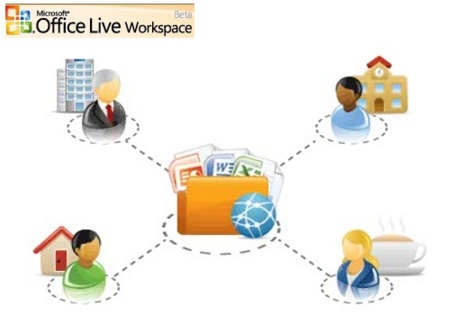
If you need to store and share Office documents - but you don't want the cost or overhead of a technology such as SharePoint - Office Live Workspace may be the answer. Deb Shinder offers a look at this free solution.
Collaboration is the name of the game in today's team-oriented business environment. Microsoft provides a number of technologies that allow computer users to work together. Midsize and large businesses may host their own SharePoint, Live Meeting, and Office Communications Services servers or subscribe to Microsoft Online Services. But for small businesses and individuals whose collaboration needs are more limited, or those who need to store documents on a remote server for backup purposes or to access when traveling, those options constitute expensive overkill. Enter Office Live Workspace, which allows you to store and share Office documents easily. And best of all, it's free.
1: Signing up and signing in
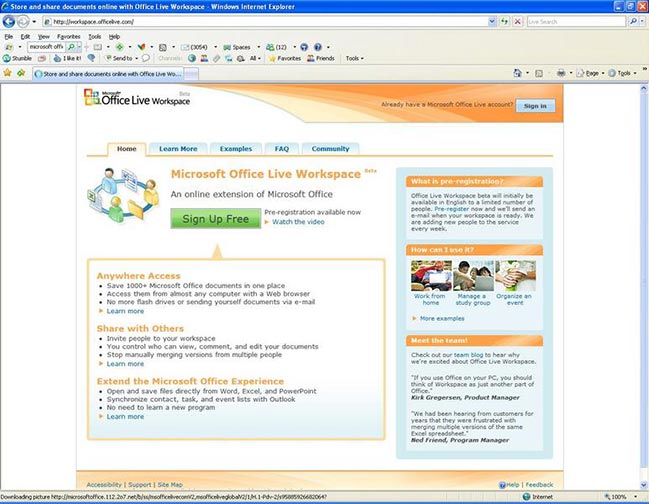
Office Live Workspace is still a beta, but you can try it out. You need an account to sign into the service. If you already have a Windows Live account, you can sign in with the email address and password associated with that account. If not, you'll be prompted to create an account when you go to http://workspace.office.live.com and click the Get Started Now button. You'll be asked for an email address, and then you'll have to fill out a form with some basic information: a password, your name, country/region, and the answer to a "secret question" (such as your mother's birthplace or the name of your first pet) for password retrieval purposes. You'll also have to decipher and type a pictogram (for discouraging bot or automated signups). You do not have to provide any credit card information; at this time, the service is free.
2: What you can do
OLW is built on SharePoint Services and gives individuals and small businesses many of the benefits of SharePoint technology without requiring that you have your own SharePoint server. Once you're signed up and signed in, you can create workspaces, which are essentially locations on Microsoft's server where you can save your Word, Excel, and PowerPoint files directly from the applications. You can also upload other files, such as PDFs and graphics. (You can't upload executables, for security reasons.) You can give others permission to access specific documents and files and you can specify whether they're allowed only to view the files or whether they can also edit them.
3: No client software required
Unlike with some other collaboration solutions, you don't have to install any extra software on your computer, nor do others have to install software to share your documents. Everything is done through the Web browser, so you can access your workspace from practically any computer that has an Internet connection.
You don't have to use Internet Explorer or Windows to use your Live Workspace account, either. In addition to IE 6, 7, or 8 running on Windows, Live Workspace supports Firefox on Windows or Mac OS X and Safari on Mac OS X.
4: Creating workspaces
When you sign into Live Workspace, you'll see a pane on the left side of the page labeled My Workspaces. A Documents workspace is created by default. To create more workspaces, click the New Workspace link. You can create separate workspaces for different projects or for sharing with different people or groups. You can create a workspace from a template or from scratch. Templates include:
- Class workspace
- Essay workspace
- Event workspace
- Household workspace
- Job search workspace
5: Uploading files directly from Office
If you have Microsoft Office installed (Office XP, 2003, or 2007), you can install the Office Live Update to integrate your local Office applications with Live Workspace.
Several updates must be installed before you can install the Office Live Update. When you run the setup program, you'll be notified if any are missing and given the opportunity to install them. Note that you'll need to close Word, Excel, and PowerPoint while you install the update. After you install the update, you'll find a new selection on the Office menu in Office 2007 programs, Save To Office Live. In Office XP and 2003 applications, the Office Live option will appear as a new toolbar.
6: Sharing with others
Sharing a document or file with others is simple. Once you've uploaded it to a workspace, you'll see a Share link that allows you to type (or select from your Windows Live address book) the email addresses of those you want to be able to view the document and those you want to be able to edit it. An email invitation will be sent to each of the addresses you selected, inviting the person(s) to share your document. You can also allow people to view the document without signing in if you wish, although this is not the default setting.
7: Collaboration features
In addition to sharing the files themselves with others, you can add comments to documents, which will be visible to anyone who has access to the documents. You can also use the versioning feature to keep track of different versions of the documents. The Activity link displays all activity relating to the document, beginning with its creation, and shows who has accessed the document, who has edited it, with whom it's been shared, etc., and the date and time of each activity. You also get email notifications when someone makes an update to one of your documents.
8: What about security?
You might be wondering about the security of documents and files you upload to Live Workspace. Be sure not to check the box to allow people to view the document without signing in if you're concerned about security. With that option disabled, only those with a Windows Live account will be able to view your shared documents. The permissions you set further restrict who can view or modify which files. In addition, the files you upload have antivirus protection from Microsoft Forefront Security for SharePoint.
9: Using OLW as a backup solution
Most individuals and small businesses recognize the importance of making backup copies of important data, but often these backups are saved to a second hard drive (internal or USB), writable DVD, flash memory card, or thumb drive and stored in the same physical location as the computer. These backups can be used if there is a hardware failure, but what if there's a natural disaster, fire, or other catastrophe that destroys the entire building? That's the reason it's important to store backups of your critical data offsite.
Office Live Workspace can be used for remote backup of your files, as you have up to 5 GB of storage space on the Microsoft server. Uploading your most important files to OLW ensures that you'll have copies of them even if disaster strikes.
10: What if you need more?
If you need more than the free Live Workspace service offers, such as email services or the ability to put up a Web site, you can also sign up for Microsoft Office Small Business. Then you get a Web site, Web hosting and design tools, a contact management system, and online business applications. You can also purchase additional features, such as premium (advertising-free) email and more storage capacity.
For a fee, you can register your own domain name and add other users (the first five are free).
Code of Conduct
Welcome to Microsoft Office Live Workspace Community
Members:
To help ensure that the Microsoft Office Live Workspace Community is a great place to meet, collaborate and interact with others, you agree to abide by this Code of Conduct. We want a positive experience for all visitors/participants.
Respect others/play fair and be a good neighbor
- Treat all other Microsoft Office Live Workspace Community participants with respect. Do not threaten, harass, stalk, or abuse other users.
- Our participants want to chat and post on our collaborative services in a positive environment.
- Do not post user-created content that advocates or encourages expressions of violence, bigotry, racism, hatred, or profanity.
- Do not spam others! Nobody likes it and spamming and scrolling in chat rooms are serious violations of online etiquette.
- Don’t impersonate or harass other participants, Microsoft employees, moderators or staff members.
- Don’t post any materials that could harm other users’ computers or would allow others to inappropriately access software or websites. No viruses, worms, Trojan horses, or bots or activities that can be disruptive to online communication.
Protect your privacy and property
- Don’t give out personally identifiable information (such as social security numbers, credit card numbers, names and addresses, telephone numbers, driver license numbers, passwords) to strangers online. This information can be used for illegal or harmful purposes.
- Parents: Be aware of and help exercise control over content posted by and activities of your children to keep them safe online.
- You are responsible for protecting your computer against interference or viruses that may be encountered on the Internet or this site. We do not screen, back up or restore user-created material stored. We recommend that you install a virus protection program on your computer and keep it up to date.
- To read the Office Live Workspace Community Privacy Statement.
Know the law
- Microsoft does not allow any illegal activities. Do not publish, post, distribute, disseminate of discuss defamatory, infringing, obscene, sexual or other unlawful material or information like child pornography or illegal drugs including images, audio, video or text.
- Do not upload files or post messages that contain photos, music, software or other material protected by intellectual property laws, rights of privacy or publicity or any other applicable law unless you own or control the rights to do so or have received necessary permission. Microsoft is not responsible for any use of anything you say or post.
- You are responsible for adhering to all local and national laws that pertain to your location.
Be responsible
- The Microsoft Office Workspace Live Community is not designed to be a primary place to store any materials; you are responsible for creating backups you post. Microsoft is not responsible for loss of, access to, deletion, alteration or restoration of any materials posted.
- You are responsible for any actions that you take based on advice or information you receive on Microsoft Office Live Workspace Community. Use your own judgment when evaluating information and remember that information provided could be from people at any age and experience level. The decision to act on any information/advice is your own and you should perform your own research prior to making any decisions.
Uphold the Code/Termination and Cancellation
- In helping to make Microsoft Office Live Workspace Community a great place to meet, chat, exchange samples and ideas and collaborate, you must do your part to uphold the Code of Conduct.
- Don’t post links to websites that violate the Code of Conduct.
- Be sure to reread this Code of Conduct once in awhile because Microsoft may update it occasionally.
- Specific groups, chats and other services may have additional guidelines for use, so be sure to review them in addition to this Code of Conduct. All activity on Microsoft Office Live Workspace Community is also governed by the Terms of Use. To read the Terms of Use.
- Microsoft will remove, without notice, any post or ban participants that are deemed objectionable or that violate this Code of Conduct.
- Microsoft is not responsible for the content or activities in any user-created message. The decision to view or engage all content is yours and we advise you to use your judgment.
Thanks for following this Code of Conduct and joining the Microsoft Office Live Workspace Community!
Workspace Team Blog
Commentary and discussion of the Workspace product: where its been, where its going, and what you can do with it.
Published Wednesday, November 07 2007
A note from the community manager
Hi.
Im what you might call the community manager. Im responsible for this platform in terms of the features and functions it delivers, how it looks, and how it evolves.
Generally speaking, we have two broad goals in mind. The first is to deliver a simple team blog: a place from which we can add our voice to the conversation. The second goal is somewhat more ambitious. In time wed like this to become a hub of activity around our services.
With regard to the former, you can expect to see posts from the product team members aligned with the following themes:
-
Workspace in the news, customer testimonials, our educational program , portal updates
-
vNext – current customer needs, vNext changes, new feature announcements
-
User experience - highlight current features, tips & tricks, support issues, user experience improvements
-
Live team – outages (in the unlikely event), upgrades, changes
-
And of course, getting to know the team.
In a few weeks, Ill take the covers off the forums -- no news there yet, just ordinary forums to support the asking and answering of questions. For a while, most of what you see will be features that come out of the box. Rest assured, however, that things will get more interesting.
How interesting? Im into the co-creation thing. Id like to build in features that permit rich interaction between product group and service user to support joint planning activities related to the Workspace product itself. Id also like the same level of support for user interaction around the key activities Workspace enables.
So, got any ideas? Whats the best service related community experience around? Should I start a Facebook group? Im not the biggest fan of Second Life, but I suppose I could be convinced to get my feet wet. Do you use del.icio.us? There are a billion (okay, perhaps only a few dozen) great services we can deliver if we integrate social bookmarking. Were already talking about integrating Twitter. And it might be cool to do something unexpected with IM. Id like to say the skys the limit, but the fact is Im on a budget. But, for the right idea...
I have few pre-conceived notions here so please get crazy and let me know the result. Better yet, send photos -- please keep it clean and in all ways professionally appropriate. (Actually, if theyre good photos, dont break any laws, and are in any way relevant, Ill post em. I swear I will.)
About me? Ive been focused on social computing from the beginning. Ive been a program manager, a product manager, a product planner, and managed teams in every capacity. (I havent slung code for several years, and I have to admit, I miss it.) Now, as a community manager Ill be doing a little of everything. If you knew me, youd know just how well that works for me.
Want to know more? Search bobreb -- most of what youll find will relate to me.
Bob Rebholz
Workspace Team Blog
Commentary and discussion of the Workspace product: where its been, where its going, and what you can do with it.
Published Monday, June 30 2008, 08:21 PM
Go Green!
by Susan Woodside, Team Editor
Hi, I’m the team editor for the Office Live Workspace User Assistance team. One of the reasons I’m excited about Office Live Workspace is that it’s a service that can replace the many pieces of paper we need to manage our busy lives with online documents that we can share with others. Remember the “paperless office?” I look at the piles of paper on my desk, and on the desks of the other editors in my office, and see that dream hasn’t arrived yet. Office Live Workspace is a step in the right direction.
But first got to get my motivation revved by some techniques I learned from Batman. Concentrate, remove distractions, use the right symbols - for this last I usually put on one of my fav shirts from the Batcave and make sure my kick boxing gloves are visible. Part of my mental prep is focused on motivation and part on endurance since that is what Batman would teach (always ask myself, "What would Batman do?"). Now I'm ready for anything!
Now let’s look at the pile next to my skull mug pencil holder. On top is a tuition bill for my son, away at school. He printed this off of his school’s Web site (they don’t mail bills to parents anymore). I have to put in a request for funds from our 529 account, see how we’re doing budget-wise, and remember to pay the bill on time. I created a new workspace called “University of Washington expenses” using the Blank workspace template. Now, my son, his grandmother in Michigan, and my husband can keep track of tuition and living expenses, as well as due dates and account numbers.
Next in the stack is a printed e-mail message from a friend with information about trip insurance… I’m going on the first cruise of my life this summer, and we are doing research about visa requirements, shore excursions, laundry on the ship. To keep all of this information organized in one place, I created a Travel workspace and shared it with my travel companions. The Travel workspace contains a number of documents, including packing and travel checklists, that you can modify to meet your needs. You can also add documents about your other travel research. For more information, see Use lists to track and share contacts, events, and tasks.
In case anyone thinks that none of my clutter is work-related, paper number three is a note showing the date for my presentation to my team about Office Live terminology. This is on my Outlook calendar, and I have some hand-outs that I’ll pass out to my group. To keep track of everyone’s presentations, we use a group workspace spreadsheet, Sign up for your demo.
One of the best ways to provide assistance without having to do all the work granularly is to use a help desk solution. I prefer Zendesk because they have out of the box functionality that is superior to most others. If you're setting up a customer service system and you wish to heavily customize it, you may want to hire a team to handle Zendesk support for you. This will empower you to create customized service that you customers will greatly appreciate, and will free you to do more important tasks, like making the rest of your office paperless.
Is my office paper-free yet? No, but we’re finding better ways to share information, and finding that workspaces help to give those buried bits exposure to the people who can benefit. For more ideas about how to save paper with Office Live Workspace, see the article Go green: 5 ways to reduce paper using Office Live Workspace.
Are workspaces helping you in an unexpected way? Let me know….
Susan Woodside, Team Editor
More Background On OfficeLiveWorkSpaceCommunity.com
OfficeLiveWorkSpaceCommunity.com served as the official community blog and user-interaction hub for Microsoft’s Office Live Workspace service during its active years, primarily 2007–2008. Although the domain now stands mostly as an archival remnant, its preserved content captures an important evolutionary moment in Microsoft’s shift toward cloud-based productivity tools, user collaboration, and web-integrated Office experiences. The site provides historical insight into early online workspaces, user-generated collaboration, and Microsoft’s initial attempts to foster a true online community built around productivity, communication, and shared digital work environments.
Based on the archived material, the site functioned as the central meeting ground for users of the Office Live Workspace beta—offering documentation, blog posts, tips, user stories, help articles, a code of conduct, and discussions led directly by members of the Microsoft Workspace product team. In effect, the site documented the ambitions, limitations, and user engagement strategies behind one of Microsoft’s earliest forays into cloud collaboration long before the emergence of OneDrive, Office Web Apps, and today’s Microsoft 365 ecosystem.
This article provides a detailed, 1600-word historical and analytic overview of OfficeLiveWorkSpaceCommunity.com, including its ownership, goals, features, community norms, user experience, culture, audience, significance, and lasting impact.
Ownership & Organizational Context
OfficeLiveWorkSpaceCommunity.com was owned and operated by Microsoft as an extension of its Office Live Workspace initiative. The community blog represented the public-facing space where members of the Workspace product team—including program managers, planners, editors, and the designated community manager—could share updates, communicate with users, and highlight new features or planned enhancements.
The site’s ownership and authorship consistently referenced roles inside Microsoft, such as:
-
Community Manager (identified in posts as Bob Rebholz)
-
Team Editor (e.g., Susan Woodside)
-
Workspace Product Team contributors
-
Support and User Assistance teams
This direct authorship from Microsoft employees indicates the site was an official channel, not a third-party or fan-run forum. The content was aligned with Microsoft’s evolving strategy to merge desktop Office software with web-based collaboration capabilities—an early form of what would eventually become the integrated Office Online/OneDrive ecosystem.
Purpose and Goals of the Site
The archived material clearly indicates two core goals:
1. Serve as an official product-team communication blog
Microsoft staff shared posts about:
-
New features and updates
-
User experience improvements
-
Educational programs and partner outreach
-
Outages, upgrades, and back-end service news
-
Customer testimonials and real-world use cases
This function helped users navigate a beta-stage platform and understand its roadmap.
2. Act as a central hub of community activity
The community manager explicitly stated the ambition to grow the site into a dynamic social environment where:
-
Users could ask questions
-
Share tips and best practices
-
Collaborate on ideas for future product enhancements
-
Participate in discussions about the Workspace service itself
The goal was not just support, but co-creation, encouraging users to influence how the Workspace platform might evolve.
Historical Background of Office Live Workspace
Office Live Workspace debuted in 2007 as a free, secure online workspace allowing Office users to store, access, and share files remotely. It offered:
-
Web-based document access
-
Automatic versioning
-
Comment threads and activity tracking
-
Permission-based sharing
-
Document collaboration with no additional client software
-
Workspace templates (class, essay, events, household, job search)
The service was pitched as a lightweight alternative to enterprise-level SharePoint—ideal for individuals, students, small businesses, and teams who needed collaboration features without enterprise infrastructure.
OfficeLiveWorkSpaceCommunity.com was launched alongside this initiative to support adoption, answer questions, and build enthusiasm.
Key Features Highlighted on the Community Site
Document collaboration
Content explained how users could share Word, Excel, PowerPoint, and PDF files, allowing collaborators to view, edit, or comment depending on assigned permissions.
Web-based accessibility
The service required no installed client software. Users could access workspaces from nearly any web-connected computer using major browsers.
Integrated Office features
For those who installed optional updates, Office applications gained “Save to Office Live” capabilities—meaning documents could be saved directly into an online workspace.
Version control & activity tracking
The community site documented how version histories, comments, and access logs helped users track changes and monitor collaboration activity.
Templates & organization tools
Workspaces could be created from specialized templates for:
-
Classes
-
Essays
-
Events
-
Household management
-
Job searches
These templates were intended to simplify structured work and improve consistency across shared groups.
Community Culture and Code of Conduct
One of the most significant preserved documents is the Office Live Workspace Community Code of Conduct, which defined the behavior expected on the platform. The code emphasized:
Respect and civility
Users were required to refrain from harassment, impersonation, bigotry, or abusive behavior. The goal was to create a positive, professional space where users felt safe participating.
Privacy protection
Users were strongly discouraged from posting sensitive information. Parents were encouraged to monitor children’s activity.
Legal compliance
No illegal content or discussion was allowed, including protected intellectual property not owned by users.
Security & responsibility
Users were reminded that Microsoft did not provide backup or restoration services for user-generated content inside the community space, and they were personally responsible for evaluating information shared by other participants.
Enforcement measures
Microsoft reserved the right to delete posts, remove users, or enforce compliance at any time.
This code reflected Microsoft’s early attempts to build professional communities around cloud services—something that would later become standard practice across platforms like Microsoft Teams and the broader Microsoft 365 environment.
Notable Content and Example Posts
Community Manager Introduction (2007)
In an early post, the community manager introduces himself as someone deeply involved in social computing from the start. He emphasizes his desire to foster “rich interaction” between users and the product team, while also contemplating integration with social platforms like bookmarking tools, instant messaging, and even early mentions of social media tie-ins. His post conveys an eagerness to experiment with community-building techniques long before such approaches were common.
“Go Green!” by the Team Editor
This post exemplifies how the site promoted real-world use cases. The editor explains how she used Office Live Workspace to reduce paper usage, track university expenses, manage travel plans, and organize work presentations. The post showed users how the service could be integrated into everyday life, blending personal productivity with family coordination and professional tasks.
“10 Things You Should Know About Office Live Workspace”
This long-form article served as an introductory guide for new users—explaining:
-
How to sign up
-
How to manage permissions
-
How to share documents
-
How to protect files
-
How to use Workspace as a backup tool
These articles helped establish the site as a hybrid of marketing, user education, and community outreach.
Audience and User Base
The community site’s content strongly suggests several intended audiences:
1. Students & Educators
The service integrated with educational programs, making it ideal for:
-
Managing class projects
-
Sharing assignments
-
Tracking academic documents remotely
2. Small Business Owners & Professionals
Posts emphasized the ability to:
-
Share files with coworkers
-
Manage business documents remotely
-
Organize tasks, events, and project timelines
3. Families and Home Users
Templates for household organization, expense tracking, and family scheduling were highlighted repeatedly.
4. Early adopters and “beta testers”
Because the service launched in public beta, the site attracted tech-savvy users willing to experiment and provide feedback.
Popularity and User Engagement
While direct analytics are not preserved, several indicators show that the community site had meaningful activity:
-
Microsoft staff actively posted content over multiple years
-
Articles reference real user stories and feedback loops
-
The Code of Conduct implies a sufficiently large audience requiring moderation standards
-
The site provided guidance on forum participation and collaboration norms
Given the era (2007–2008), this level of community infrastructure demonstrates Microsoft’s commitment to testing online collaboration services on a broad consumer scale.
Cultural & Technological Significance
OfficeLiveWorkSpaceCommunity.com holds historical significance for several reasons:
1. Early cloud collaboration
It predated widespread cloud tools, offering one of the first mainstream ways to store and share Office documents online.
2. Predecessor to OneDrive and Microsoft 365
The concepts pioneered—web-based storage, online editing, real-time collaboration, identity-driven permissions—foreshadowed Microsoft’s future platforms.
3. User-driven product feedback
Microsoft used the community to gather ideas directly from users, influencing future development.
4. Encouraging digital literacy
Blog posts illustrated practical uses for online collaboration that helped users transition from offline work habits to web-based workflows.
5. Early corporate community management
The active presence of Microsoft employees—including candid, conversational posts—was unusual for the time and showed Microsoft experimenting with more transparent customer engagement.
Legacy and Long-Term Impact
Although Office Live Workspace was eventually discontinued and replaced by more advanced services, the site’s legacy includes:
-
Establishing community-driven development norms
-
Validating user interest in cloud-stored documents
-
Shaping Microsoft’s later Office Online and OneDrive integration
-
Providing one of the earliest structured Microsoft-run productivity communities
-
Demonstrating early best practices in online community conduct and moderation
The archived content serves as a snapshot of Microsoft’s transition from a software-only company to a major cloud-services provider.
OfficeLiveWorkSpaceCommunity.com was far more than a simple blog; it was the foundational community space supporting one of Microsoft’s earliest cloud collaboration initiatives. Through its articles, code of conduct, user stories, and direct product-team engagement, the site documented the early evolution of web-based productivity, long before widespread cloud adoption. Today, it stands as a historical reference point showing how digital work habits, collaboration standards, and community-managed platforms evolved during a pivotal era.
This fixed, link-free article captures the website’s purpose, context, user base, features, educational value, and its lasting contribution to the broader development of Microsoft’s online productivity ecosystem.